PUBLICATIONS & RESEARCH OUTPUTS

Cybersecurity-Informed Anomaly Detection for Prepaid Electricity Consumers

A record of methods, manuscripts and ongoing work. Each item states its current research status.

IIMEEE / RESEARCH

Behavioral Anomaly Screening for Prepaid Metering

Manuscript in preparation • Not submitted for authority acknowledgement or journal publication

This project investigates a screening approach that combines prepaid recharge behavior with metering-record integrity checks. Its purpose is to identify unusual records for review and field verification, rather than to establish theft or cyberattack outcomes.

Public research abstract

This project investigates an interpretable screening framework for unusual prepaid electricity transaction patterns. Descriptive features of recharge frequency, variability, inactivity and reactivation are considered alongside independent record-integrity checks. Complementary unsupervised approaches, including Isolation Forest and Local Outlier Factor, may support prioritization of records for investigation. Anomaly scores are review signals, not proof of theft, tampering or cyberattack. Without independently confirmed ground-truth cases, detection accuracy and case prevalence cannot be established; operational use would require subsequent validation and appropriate human review.

Research question

Unusual recharge patterns can arise from many causes, including changes in activity, affordability, transaction timing, or record errors. A useful screening process needs both contextual behavioral analysis and independent integrity checks.

Approach

Behavioral features describe recharge activity, variability, dormancy, reactivation, and peer differences. Isolation Forest and Local Outlier Factor provide complementary unsupervised signals, while a separate rule layer checks record integrity. The combined evidence supports review prioritization and subsequent verification.
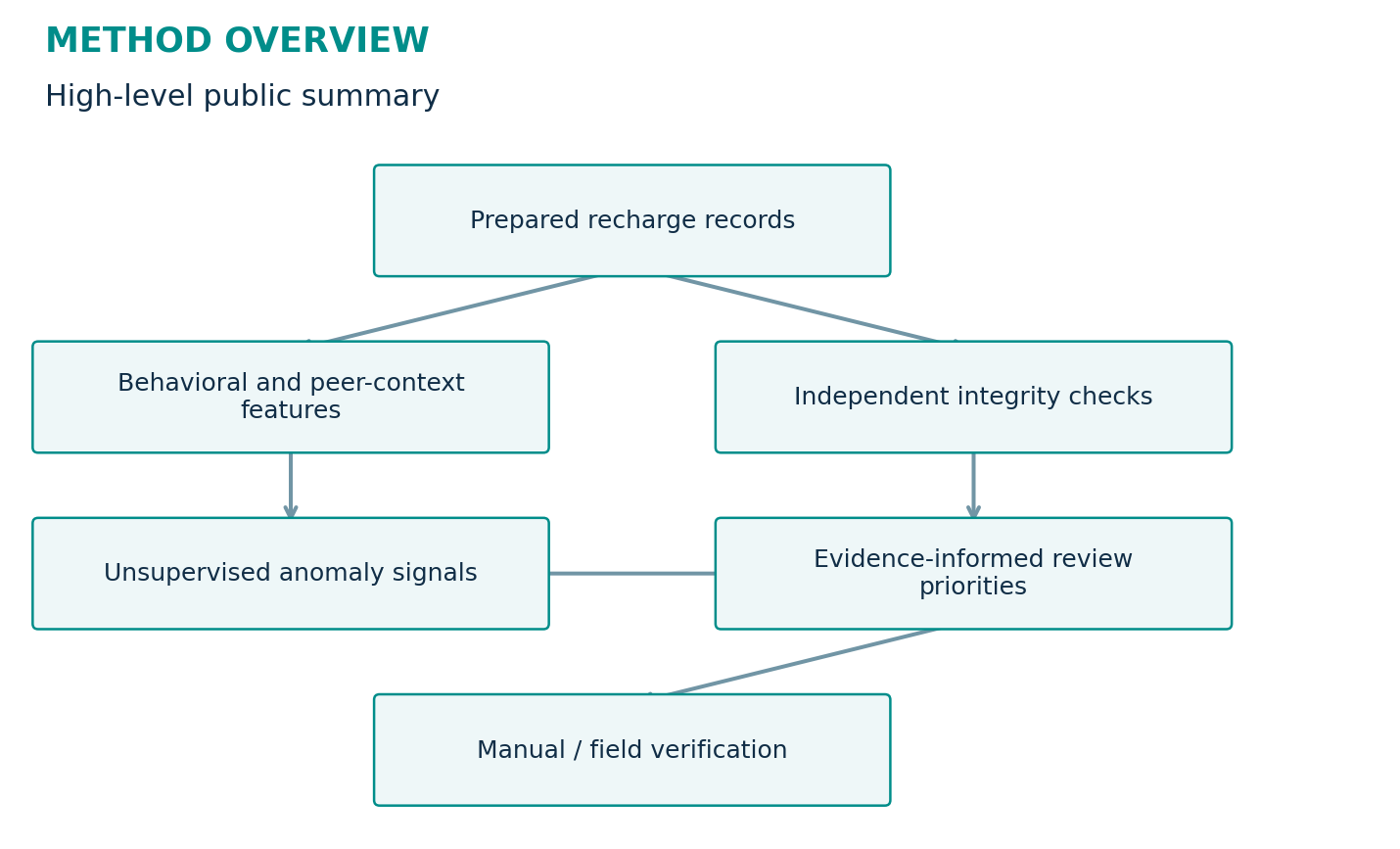
High-level methodology overview for Cybersecurity-informed anomaly screening
High-level methodology overview. Detailed implementation and empirical outputs remain outside this public highlight.

Research highlights

  • Combines global and local unsupervised anomaly signals.
  • Keeps record-integrity checks visible alongside behavioral analysis.
  • Treats screening outputs as review indicators requiring independent verification.

Illustrative simulation — synthetic, not empirical
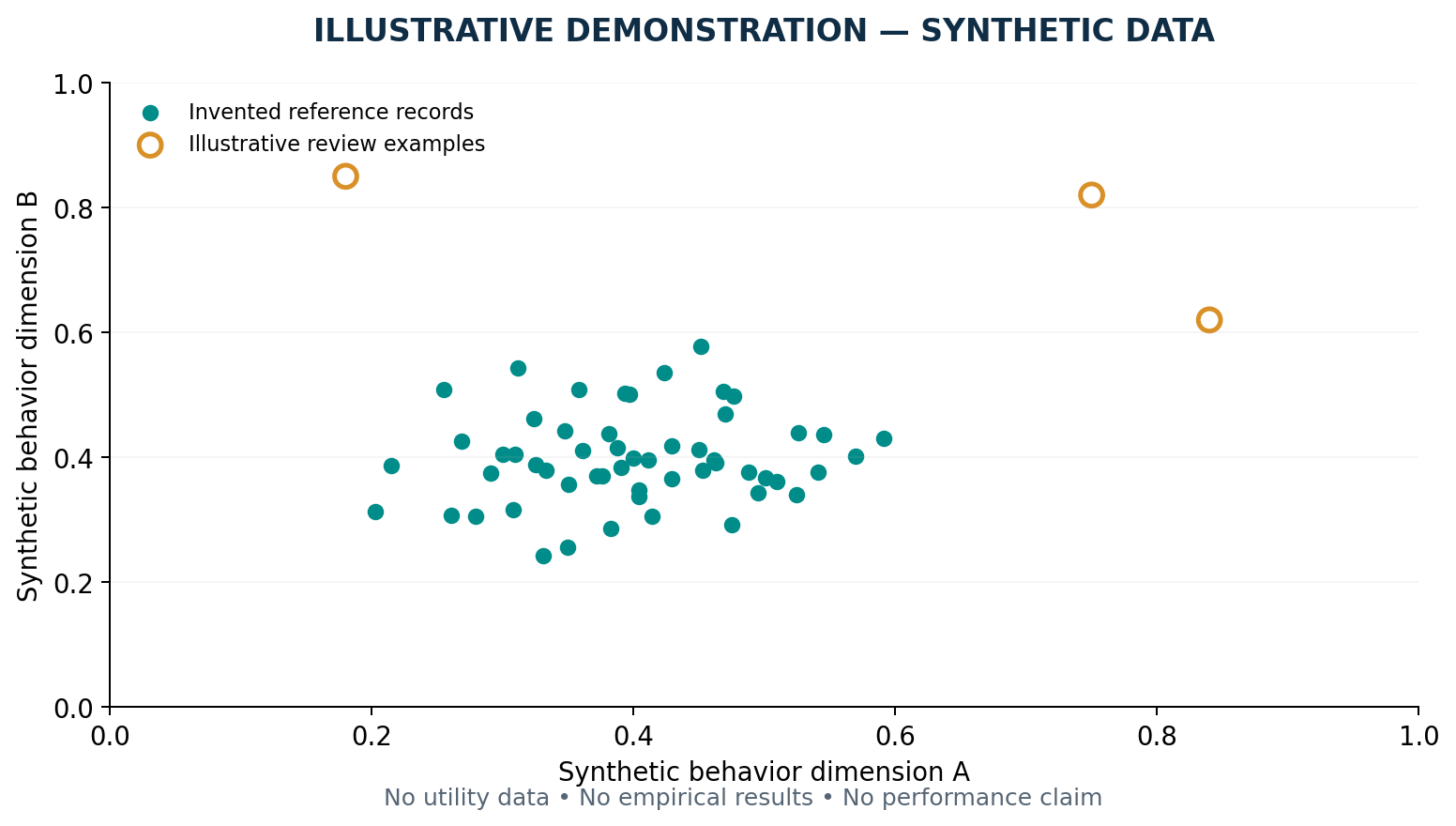
Synthetic educational demonstration for Cybersecurity-informed anomaly screening
Synthetic feature-space illustration using invented points. Marked records are examples for review, not confirmed theft cases. This figure is not a fitted model output, risk-rate estimate, or validated security result.

Intended application

The research explores how routine transaction records can support structured metering-integrity review where confirmed labels and detailed telemetry are limited.

Scope and limitations

Confirmed tampering labels are unavailable, so theft-detection accuracy, precision, and recall are not established. Separation of score-defined groups is not independent validation of fraud detection. Unusual behavior and identity conflicts may have legitimate or administrative explanations.

Disclosure: The illustrations use invented demonstration data. No consumer-level data, operational case details, confirmed anomaly labels, real fitted-model performance results, or unreleased manuscript are disclosed. Public release remains subject to coauthor, data-owner and intended-journal permissions.

Independent research portfolio overview by Bikash Halder. Manuscript in preparation. This page does not imply utility endorsement, authority acknowledgement, journal acceptance, or operational deployment.
01

Methodology study

Prepaid energy reconstruction

From irregular recharge records to a transparent estimate of monthly energy use.

Manuscript in preparationView overview

Methodology study

Prepaid energy reconstruction

From irregular recharge records to a transparent estimate of monthly energy use.

Manuscript in preparation

Research question

How can monthly used energy be estimated when recharge transactions are available but independent meter readings are absent?

Approach

Combine personal rolling recharge patterns, tariff seasonality and an activity-weighted blend with a balance carry-forward simulation. Estimated usage is capped by available prepaid credit.

Contribution

An auditable reconstruction method for prepaid consumer analysis that distinguishes purchased energy from estimated energy use.

Evidence & limitations

Reconstructed kWh is an estimate, not metered ground truth. Opening-balance assumptions and small peer groups affect the result. No unreleased numerical results are presented here.

Next step

Validate against independent meter or balance observations and document sensitivity to initial balances.

Methodology stages

01 / Recharge history

02 / Seasonal target

03 / Balance simulation

04 / Estimated used kWh

Open full page
02

Consumer analytics study

Hybrid utility analytics

A common analytical view of prepaid and postpaid electricity records, with evidence types kept visible.

Manuscript in preparationView overview

Consumer analytics study

Hybrid utility analytics

A common analytical view of prepaid and postpaid electricity records, with evidence types kept visible.

Manuscript in preparation

Research question

How can a utility compare consumer behavior across prepaid and postpaid metering without treating recharges as measured consumption?

Approach

Construct a consumer-month panel, normalize feeder and tariff categories, label observed postpaid energy separately from reconstructed prepaid usage, and compare seasonal and peer-group behavior.

Contribution

A reproducible route from routine workbooks to consumption profiles and data-quality screening.

Evidence & limitations

Observed billing records and reconstructed prepaid values have different uncertainty. Entity collisions and aggregation need reconciliation. Behavioral patterns alone do not establish causal drivers.

Next step

Complete identity reconciliation and strengthen independent validation of reconstructed prepaid usage.

Methodology stages

01 / Billing & vending

02 / Panel & source labels

03 / Peer-group profiles

04 / Research screening

Open full page
03

Unsupervised ML study

Prepaid anomaly screening

Unsupervised behavioral screening to prioritize records for verification.

Manuscript in preparationView overview

Unsupervised ML study

Prepaid anomaly screening

Unsupervised behavioral screening to prioritize records for verification.

Manuscript in preparation

Research question

Which unusual recharge and identity patterns warrant further examination when confirmed theft labels are unavailable?

Approach

Engineer behavioral and integrity features, combine Isolation Forest and Local Outlier Factor signals, and apply a separate rule-based identity and tariff consistency layer.

Contribution

An interpretable screening framework that can guide subsequent record review and field verification.

Evidence & limitations

An anomaly is not proof of theft, meter bypass or a cyberattack. Risk tiers need inspection-based validation; recharge-only records cannot diagnose a physical mechanism.

Next step

Link authorized inspection outcomes to model flags and evaluate precision, false positives and stability.

Methodology stages

01 / Behavioral features

02 / IF + LOF ensemble

03 / Integrity checks

04 / Verification priority

Open full page
04

Probabilistic ML study

Sanctioned-load decision support

Observed energy forecasts and physically valid lower bounds for an auditable review workflow.

Manuscript in preparationView overview

Probabilistic ML study

Sanctioned-load decision support

Observed energy forecasts and physically valid lower bounds for an auditable review workflow.

Manuscript in preparation

Research question

How can monthly billing evidence support sanctioned-load review when actual maximum-demand measurements are unavailable?

Approach

Train XGBoost Q70/Q80/Q90 models on observed next-month kWh. In a separate evidence layer, use observed E/H as average power, a physical lower bound on maximum demand, with consecutive-month persistence.

Contribution

A no-pseudo-target workflow linking observed energy forecasting with conservative evidence for review. No assumed load factor or synthetic demand label is used.

Evidence & limitations

Energy quantiles are not maximum-demand predictions. The lower-bound test can miss exceedance. Any load change requires actual-demand or field verification and the applicable approval process.

Next step

Review the manuscript and verification protocol with the utility before external submission.

Methodology stages

01 / Observed monthly kWh

02 / Quantile forecasting

03 / E/H lower bound

04 / Verification & review

Open full page
05

Active research workflow

Probabilistic forecasting & DSM

One-month-ahead energy forecasts connected to bounded demand-side scenarios.

Data audit in progressView overview

Active research workflow

Probabilistic forecasting & DSM

One-month-ahead energy forecasts connected to bounded demand-side scenarios.

Data audit in progress

Research question

Can calibrated monthly forecasts support consumer-to-feeder prioritization and defensible energy-shaping scenarios?

Approach

Audit the consumer-month panel, compare chronological baselines, then evaluate quantile boosting with pinball loss and coverage. Keep observed postpaid targets separate from estimated prepaid targets.

Contribution

A practical research protocol linking uncertainty-aware forecasts to explicitly assumed conservation and energy-shaping scenarios.

Evidence & limitations

One annual cycle limits seasonal generalization. Monthly bills do not establish hourly peaks or actual flexible capacity. Consumer quantiles cannot simply be summed as feeder quantiles.

Next step

Reconcile sources and panel keys, finish the data audit and run common-origin forecast baselines.

Methodology stages

01 / Audited monthly panel

02 / Temporal backtesting

03 / Calibrated quantiles

04 / DSM scenarios

Open full page
06

PhD research direction

Renewable-integrated grid resilience

A longer-term direction connecting probabilistic analytics, flexibility and distribution-network decisions.

Research conceptView overview

PhD research direction

Renewable-integrated grid resilience

A longer-term direction connecting probabilistic analytics, flexibility and distribution-network decisions.

Research concept

Research question

How can uncertainty-aware decision support help distribution systems integrate renewables and respond to operational stress?

Approach

Extend validated forecasting and flexibility models toward constrained network studies using time-aligned demand, renewable, topology and equipment measurements.

Contribution

A research direction informed by practical distribution operations and data-driven engineering.

Evidence & limitations

This is a proposed direction. No validated renewable dispatch, network feasibility or resilience improvement is claimed.

Next step

Develop a verified interval dataset and network model, then define defensible resilience metrics.

Methodology stages

01 / Interval & network data

02 / Uncertainty models

03 / Constrained decisions

04 / Resilience evaluation

Open full page
07

Proposed IIMEEE project

Mechanical condition monitoring

A proposed benchmark study of machine degradation and transparent model validation.

Research conceptView overview

Proposed IIMEEE project

Mechanical condition monitoring

A proposed benchmark study of machine degradation and transparent model validation.

Research concept

Research question

How can documented run-to-failure data support a reproducible condition-monitoring baseline?

Approach

Begin with a documented public dataset, define the task and labels, split by complete experimental run, and compare simple baselines with candidate prognostic models.

Contribution

A proposed extension of IIMEEE into mechanical reliability and maintenance research.

Evidence & limitations

This is a new concept for the expanded portfolio. No experiments, remaining-life accuracy or industrial validation are claimed.

Next step

Select and inspect a dataset, then agree the benchmark protocol before training.

Methodology stages

01 / Documented dataset

02 / Task & baseline

03 / Run-level evaluation

04 / Transfer validation

Open full page
08

Proposed IIMEEE project

Embedded sensing for engineering research

A proposed instrumented prototype connecting physical measurements to reproducible analysis.

Research conceptView overview

Proposed IIMEEE project

Embedded sensing for engineering research

A proposed instrumented prototype connecting physical measurements to reproducible analysis.

Research concept

Research question

How can an embedded sensing pipeline preserve measurement quality and traceable records?

Approach

Define measurement requirements, compare documented controller and sensor options, prototype acquisition and validate timestamps, units and measurement behavior against a reference.

Contribution

A proposed bridge between electronics prototyping and mechanical or energy-data studies.

Evidence & limitations

No hardware has been selected, purchased or tested. Component specifications alone do not validate a complete measurement system.

Next step

Choose an exact application, sensing range, sampling need and reference measurement before selecting hardware.

Methodology stages

01 / System requirements

02 / Hardware shortlist

03 / Acquisition prototype

04 / Reference validation

Open full page